494 Alteryx Challenges Later: What I Learned From Nearly Completing the Archive
What Was I Thinking?
I originally started the Alteryx Weekly Challenges for one simple reason: I wanted to get better faster.
At the time, I already understood the basics of Alteryx Designer. I could build workflows, join datasets together and produce outputs. But there is a massive difference between knowing where the tools are and becoming genuinely fluent with the platform. The Weekly Challenges ended up becoming the single best deliberate-practice system I have found for developing that fluency.
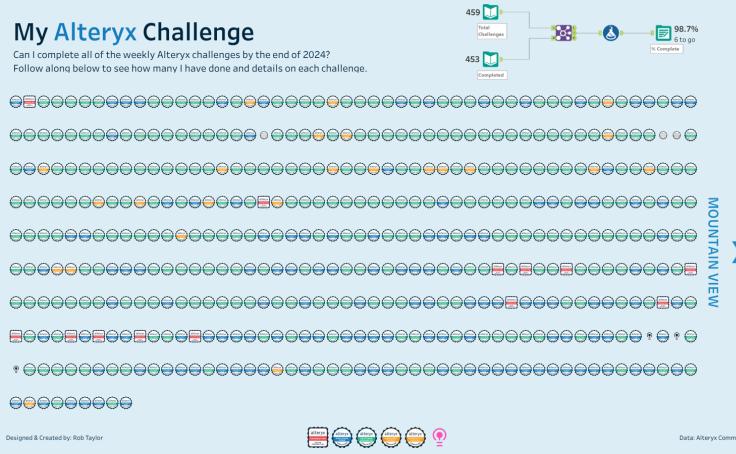
Over 260 days I completed 494 out of the 500 available challenges. That works out to a completion rate of 98.8%. But the numbers are only part of the story. The real value came from repetition.
The constant cycle of:
- Understanding messy requirements
- Working through imperfect datasets
- Finding multiple ways to solve the same problem
- Discovering better workflow patterns
- Learning where Alteryx can break
- Learning how to simplify workflows
- Building instinct for tool selection
Eventually, certain problems stopped feeling difficult. You begin recognising patterns almost immediately.
The Early Challenges: Learning by Repetition
The first few dozen challenges were less about advanced techniques and more about repetition. A lot of the work involved:
- Date parsing
- Joins
- Multi-row calculations
- Text parsing
- Crosstabs
- Data cleansing
- Dynamic renaming
- Filtering logic
- Sorting and summarising
At first, even relatively simple tasks could feel awkward. One challenge involved parsing multiple inconsistent date formats using Regex expressions:
.*(\d\d-[[:alpha:]][[:alpha:]][[:alpha:]]-\d+)
.*(\u\l\l\s\d+,*\s\d\d+)
Another required using Generate Rows alongside ToNumber functions to split out postal areas correctly. Another challenge focused entirely on running averages using Multi-Row formulas. None of these techniques are individually difficult once you understand them. The difficult part is learning when to use them instinctively. That only comes from repetition.
The Month Everything Accelerated
My biggest month was May 2024, where I completed 143 challenges. That period completely changed how I approached Alteryx. At the beginning of the month, I was still thinking tool-by-tool. By the end of it, I was thinking workflow-first. Instead of asking: “What tool do I need next?” I had started asking: “What structure does this workflow need?” That shift matters. Because once you stop thinking linearly, you begin designing workflows much more intentionally.
You start recognising recurring patterns:
- Standardise the data first
- Build reusable logic
- Reduce branching
- Aggregate late where possible
- Preserve keys before transposing
- Keep workflows readable
- Design for debugging
The challenges reinforced those habits constantly.
The Biggest Skill Gains
Looking back through my notes, several themes appear repeatedly.
1. Parsing and cleaning messy data
This came up constantly. HTML parsing, JSON parsing, inconsistent dates, embedded delimiters, newline characters, malformed headers and irregular structures. Some challenges involved downloading data directly via the Download tool and then parsing nested JSON structures before restructuring everything using Crosstab, Union and Dynamic Rename. Others involved manually rebuilding tables from badly formatted HTML. These types of exercises are incredibly valuable because real-world data is rarely clean. Most business problems are actually data quality problems in disguise.
2. Joins and relationship thinking
A huge number of challenges involved joins. Not just basic joins either. There were self-joins, many-to-many relationships, hierarchy building, appending datasets together before re-matching them and using Record IDs strategically to preserve relationships after transformations. One hierarchy challenge involved repeatedly joining the dataset back to itself to build reporting levels. Another involved creating warehouse assignment logic using sorting, multi-row formulas and allocation calculations. Over time, you stop seeing joins as individual tools. You start seeing them as relationship logic. That mindset shift is important.
3. Multi-Row formulas and stateful logic
Multi-Row formulas appeared everywhere. Running totals. Distance calculations. Allocation logic. Retention calculations. Previous-row comparisons. Early on, Multi-Row formulas felt awkward. Later, they became one of the first tools I would reach for. The same applies to iterative thinking in general. Several challenges could be solved conventionally or using iterative macros. Those exercises helped build a much better understanding of process-driven workflow design.
4. Macros and dynamic workflows
The challenges become significantly more interesting once macros start appearing regularly. This is where workflows begin moving beyond static transformations. Some examples included:
- Building dropdown-driven applications
- Creating reusable processing logic
- Dynamic file handling
- Parameter-driven calculations
- Iterative hierarchy generation
- Batch processing workflows
Macros completely change how you think about scalability inside Alteryx. Once you become comfortable with them, you stop building workflows for single-use cases. You start building systems.
The Challenges That Changed My Thinking
A few challenges stood out because they introduced tools or concepts I had never properly used before.
One challenge introduced:
- Association Analysis
- Linear Regression
- Score tools
Another involved spatial route calculations using:
- Centroids
- Distance calculations
- PolyBuild
- Spatial grouping
Those challenges mattered because they pushed me outside my normal comfort zone. That is one of the biggest strengths of the Weekly Challenges archive. It forces breadth. You cannot stay inside your preferred toolset forever.
What Improved Most
The biggest improvement was not technical knowledge. It was workflow confidence. After several hundred challenges:
- You debug faster
- You spot bad data earlier
- You anticipate edge cases
- You simplify workflows more aggressively
- You become less intimidated by messy inputs
- You develop much stronger pattern recognition
- You become comfortable rebuilding workflows entirely
The speed difference becomes noticeable too. Problems that originally took over an hour eventually become 10-minute exercises. Not because the problems became easier. Because your workflow instincts improve.
Why Deliberate Practice Works
The Weekly Challenges work because they create deliberate repetition. You are repeatedly exposed to:
- Different industries
- Different data structures
- Different problem types
- Different optimisation approaches
- Different workflow styles
That repetition compounds surprisingly quickly. A single challenge teaches a technique. Hundreds of challenges teach judgement. And judgement is what separates someone who can use Alteryx from someone who is genuinely fluent with it.
The Final 6 Challenges
I never reached the full 500. The remaining challenges are:
- 99
- 397
- 399
- 401
- 479
- 500
Part of me is frustrated I didn't complete the lot, but honestly, completing 494 challenges already changed the way I work with data permanently. It was always going to be an impossible full sweep, because for one of them the data link no longer worked, so even if I had completed the lot, it would have been a pointless exercise.
The Final Thread
If you are trying to improve in Alteryx, there is no shortcut that replaces repetition. Courses help. Documentation
helps. YouTube tutorials help. But building hundreds of workflows forces a completely different level of understanding.
The Weekly Challenges helped me move from: “I know how to use Alteryx” to “I know how to solve problems with
Alteryx.” And those are not the same thing. If you have never tried the Weekly Challenges archive before, I would
strongly recommend it. And don't forget: if you get really stuck,
the Alteryx Weekly Challenge community
is a great place to see how others solved each challenge.
Just do not underestimate how addictive it becomes once you start seeing your workflow thinking improve in real time.
You never know, it may open opportunities to collaborate with others
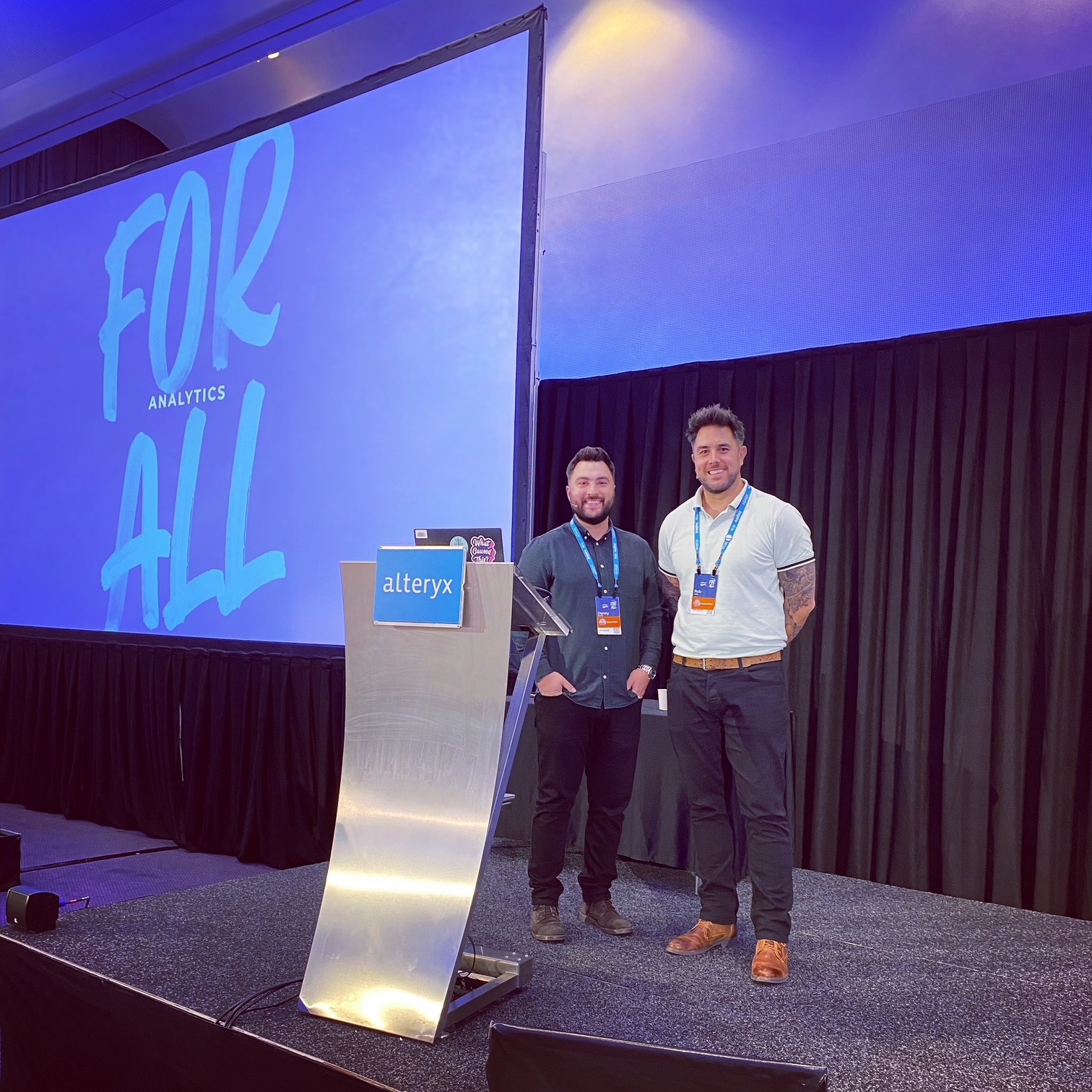
or allow you to present at a conferfence one day. Here I am with
Danny Bradley
presenting at Alteryx Inspire EMEA in Amsterdam in 2022.
Rob